In this post, I'm going to talk about a problem on leetcode which asks us to find all the possible subsets of given list of integers.
This problem is the base to solving other problems like subset sum and subset partitioning which I'll be discussing in coming posts.
Let's get started:
I'll be solving this problem using 2 techniques:
Problem Statement: Given a set of distinct integers, nums, return all possible subsets (the power set).
Note: The solution set must not contain duplicate subsets.
Example: Input:
 Let
Let
Recursive Cases: For every state i.e
Include current element in the subset
Base Cases:
Let’s think of base cases. The base cases are:
- Using Recursion
- Using Bitset
Problem Statement: Given a set of distinct integers, nums, return all possible subsets (the power set).
Note: The solution set must not contain duplicate subsets.
Example: Input:
nums = [1,2,3]
[
  [3],
  [1],
  [2],
  [1,2,3],
  [1,3],
  [2,3],
  [1,2],
  []
]
Solution
1. Using Recursion
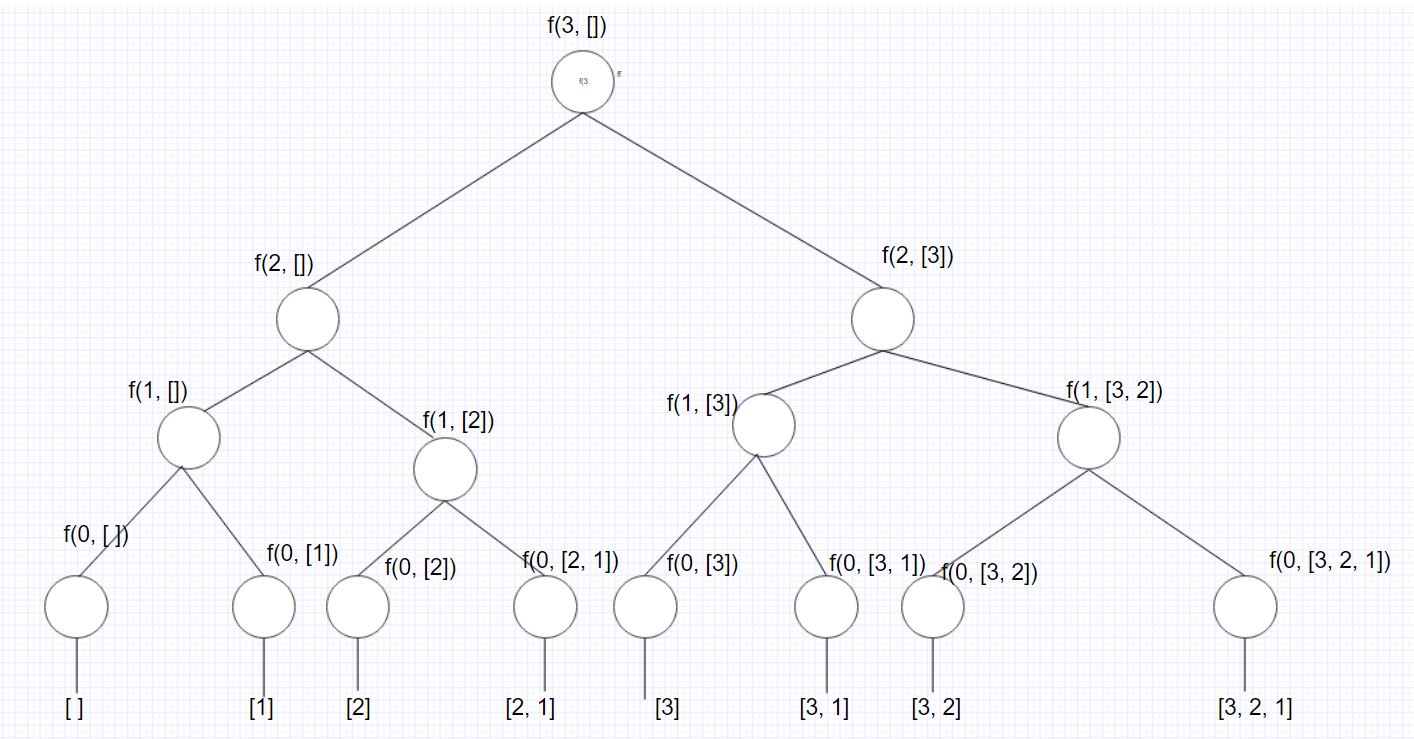
Firstly, I'll be discussing recursive approach to subset finding problem. Recursive problem is easy to visualise. Consider the given testcase[1, 2, 3].
Let solve(nums, n, subset) be the function that find subsets for array nums and number of elements n, initially called with an empty subset.
So our initial call is :vector<int>subset;
solve(nums, nums.size(), subset);
Recursive Cases: For every state i.e
(n), i,e position n - 1 of solve(nums, n, subset)
- Don’t include the current element in the subset i.e simply call
solve(nums, n - 1, subset);
subset.push_back(arr[n -  1]);
solve(nums, n -  1, subset);
Let’s think of base cases. The base cases are:
- If
n == 0i.e no item left push the currentsubsetto oursubsets_which is a vector of vector.
if (n == 0){
subsets_.push_back(subset);
return;
}
class Solution {
public:
// Vector of vector of int to store all the subsets
vector<vector<int>> subsets_;

// Solve method that generates subset recursively
void solve(vector<int> &nums, int n, vector<int> subset){
    // If size of array becomes 0, no elemnts are left
    // We push current subset to our subsets_ and return
    if (n == 0){
        subsets_.push_back(subset);
        return;
    }
    // Else we have 2 options:

    // Don't include the current element to subset
    solve(nums, n - 1, subset);
    // Incldue the current element in subset
    subset.push_back(nums[n - 1]);
    solve(nums, n - 1, subset);
}

// Solution method subsets
vector<vector<int>> subsets(vector<int>& nums) {
    // Make an empty vector subset
    vector<int> subset;
    // Call solve function initially with an empty subset
    solve(nums, nums.size(), subset);
    // Return subsets after calculation
    return subsets_;
}
};
2. Using Bitset
I have explained the bitset method on quora.