How to save offline documentation of language, framework or tools

Frequently, I have found myself going back and forth through the official documentation of language or frameworks.

This kind of gets annoying sometime when the internet is slow and I have to frequently go back to google and type "X documentation" and opening the links and searching for function or feature I'm looking for. That's a lot of work.

Recently, I found a great tool called Zeal which is completely free and offers offline documentations for about 194 great libraries, frameworks and languages like C++, Python, jQuery, React, Angualar, Laravel, Flask , Django and many more.

enter image description here

You can directly download this tool from the official link https://zealdocs.org/. This works on both linux and windows platform.
Share:

Project Euler 37: Truncatable Prime

I read the problem statements from both of the problems on hackerrank and project euler.
The problem at hackerrank is more general and has specific constraints. Here is the problem statement:
The number 3797 has an interesting property. Being prime itself, it is possible to continuously remove digits from left to right, and remain prime at each stage: 3797 , 797, 97, and 7. Similarly we can work from right to left: 3797 , 379, 37, and 3. Find the sum of primes that are both truncatable from left to right and right to left below N. NOTE: 2, 3, 5, and 7 are not considered to be truncatable primes.
The constraints for N is 100 <= N <= 10^6

Solution:
The problem statement is pretty clear about what we want to do. Basically, we call a number prime truncatable if
  • The number is at least 2 digits
  • we continuously remove digits from left to right and the results are prime
  • we continuoulsy remove digits from right to left and the results are prime
We are asked to find the sum of truncatable prime numbers below any N?
The first idea that comes to find is to iterate every odd number (2 is the only prime even number) starting from 11 up to (N - 1) and checking if the number is truncatable.
This idea roughly translates to:
sum = 0
 for i in range(11, n, 2): 
     if all[i]:
         if is_truncatable(i):
             sum += i
Don’t worry about the function is_truncatable(). We’ll be implementing it in a while.
How efficient is the code? This naive code gets TLE. We’re simply bruteforcing for all the odd numbers. Do we actually need all these computations? Or, is there a better way to reduce computations?
Let’s think for a while… What if we can generate all the prime numbers below N beforehand and check for just the prime numbers as the number has to be prime first to be a truncatable prime number?
The best method to generate prime numbers is using the sieve. I'll be using Sieve of Eratosthenes .
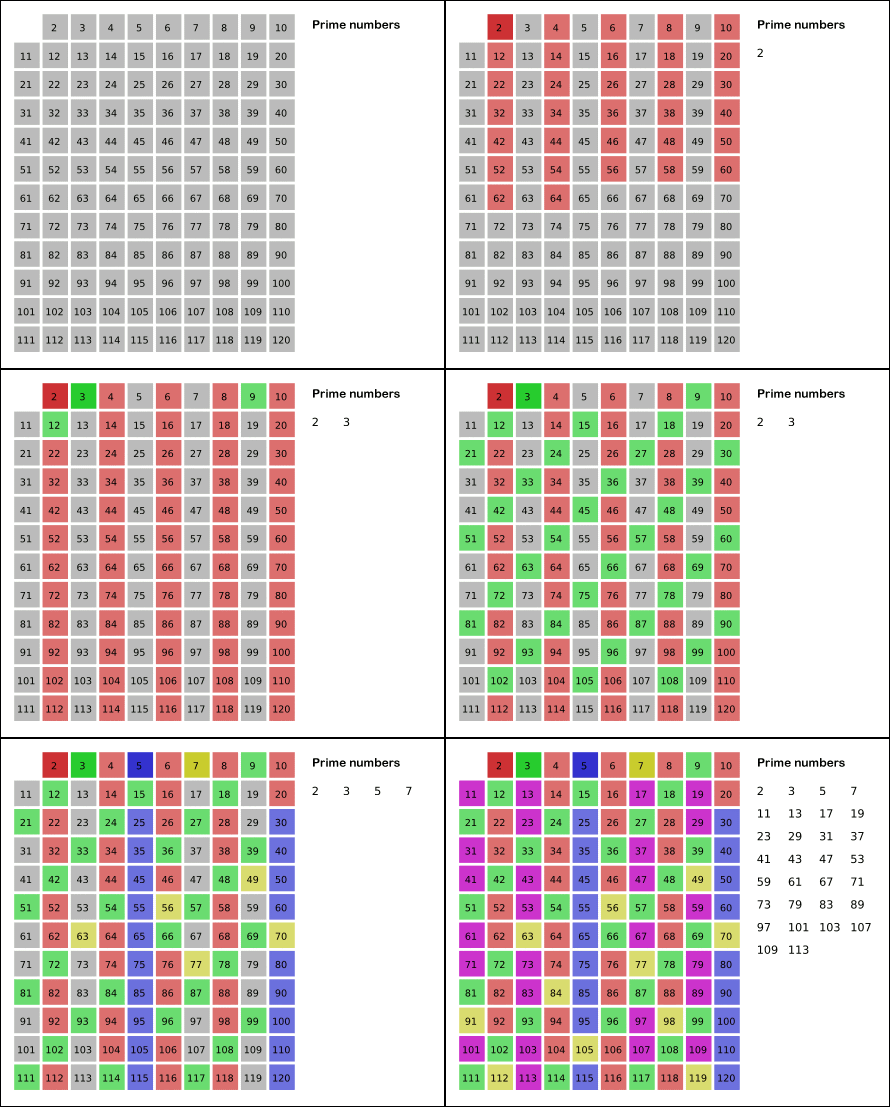
Suppose, we have to generate all the prime from 1 to 120.
The basic idea of the sieve of erasthonses is:
  • Make an array of size 121(0 Based Indexing).
  • Mark all the numbers as prime initially.
  • Strikeout all the multiples of 2 by marking them as non-prime.
  • Similarly, strike out all the multiples of 3 and so on
  • Finally, we’ll get an array of boolean value.
See the below visualization from Wikipedia.

Translating, the sieve of erasthonses is straightforward.
MAX = 1000000
prime = [True] * (MAX + 1)

def sieve():
    global prime
    prime[0] = prime[1] = False
    for i in range(2, MAX + 1):
        if i * i > MAX:
            break
        for j in range(i * i, MAX + 1, i):
             prime[j] = False
Let’s revisit the _istruncatable() function and try to implement the code.
  • Start from a number N
  • Remove digit from left one by one
  • After removing, if the number is nonprime then immediately return false.
  • Else continue removing digits until no digits are left.
Use the same logic for removing digit from right by one. This translates to:
def is_truncatable(n):
    quo = n
    rev = 0 
    while quo:
        rem = quo % 10;
        rev = rev * 10 + rem;
        # eg: For n = 3797
        # These pairs are checked 
        # 7 3797
        # 97 379
        # 797 37
        # 3797 3
        # print(reverse_digits(rev), quo)

        # If both of the pairs are prime continue
        if prime[reverse_digits(rev)] and prime[quo]:
            quo //= 10
            continue

        # Else immediately return false
        return False
    # If none of the pairs fails, it is a truncatable prime
    return True
If it doesn't make sense, you can 2 passes or use str() and int() builtins. We need to implement _reversedigits() function as:
def reverse_digits(n):
    quo = n 
    rem = 0 
    rev = 0
    while quo:
        rem = quo % 10;
        rev = rev * 10 + rem;
        quo //= 10;
    return rev
Here is our final code :
#Author: Bishal Sarang
 
MAX = 1000000
 
prime= [True] * (MAX + 1)
 
# Reverse a number 
# 123 -> 231
def reverse_digits(n):
    quo = n 
    rem = 0 
    rev = 0
    while quo:
        rem = quo % 10;
        rev = rev * 10 + rem;
        quo //= 10;
    return rev
 
 
def is_truncatable(n):
    quo = n
    rev = 0
    while quo:
        rem = quo % 10;
        rev = rev * 10 + rem;
        # eg: For n = 3797
        # These pairs are checked 
        # 7 3797
        # 97 379
        # 797 37
        # 3797 3
        # print(reverse_digits(rev), quo)
 
        # If both of the pairs are prime continue
        if prime[reverse_digits(rev)] and prime[quo]:
            quo //= 10
            continue
        
        # Else immediately return false
        return False
    
 
    # If none of the pairs fails, it is a truncatable prime
    return True
 
 
def sieve():
    global prime
    prime[0] = prime[1] = False
    for i in range(2, MAX + 1):
        if i * i > MAX:
            break
        for j in range(i * i, MAX + 1, i):
             prime[j] = False
        
 
def main():
    sieve()
    sum = 0;
    n = int(input())
    
    # For all the odd numbers starting from 11 to n - 1
    # If it is a prime, then check for truncatability
    for i in range(11, n, 2): 
        if prime[i]:
            # If truncatable prime
            # Increase the sum
            if is_truncatable(i):
                sum += i
    
    print(sum)
 
if __name__ == "__main__":
    main()
Here is the code that uses string to int and int to string conversion.
#Author: Bishal Sarang

MAX = 1000000
prime= [True] * (MAX + 1)

def is_truncatable(n):
    s = str(n)
    t = s[::-1]
    # If none of the pairs fail, it is a truncatable prime
    return all((prime[int(s[:j])] and  prime[int(t[:j][::-1])] for j in range(1, len(s) + 1)))
 

def sieve():
    global prime
    prime[0] = prime[1] = False
    for i in range(2, MAX + 1):
        if i * i > MAX:
            break
        for j in range(i * i, MAX + 1, i):
             prime[j] = False
        

def main():
    sieve()
    sum = 0;
    n = int(input())
    # For all thhe odd numbers starting from 11 to n - 1
    # If it is a prime, then check for truncatability
    for i in range(11, n, 2): 
        if prime[i]:
            # If truncatable prime
            # Increase the sum
            if is_truncatable(i):
                sum += i
    print(sum)

if __name__ == "__main__":
    main()
Share:

Yatra 3.0 Coding Competition

I recently participated in a coding competition organized by National College of Engineering(NCE) at Yatra 3.0. I'll be sharing my experience in this blog post.

Here is the info about the contest:

  • There were 7 programming questions, out of which we were required to solve any 5.
  • No internet was allowed.
  • The only languages allowed were C and C++.
  • Total time available was 1:30 mins.
  • The evaluation was done on the basis of correctness and tie was broken by submission time.

The problems were not that hard if you have done some programming before.

  1. WAP to find the sum of digits of a given number until you reach a single digit.
  2. WAP to print a string N times without using any loop.
  3. WAP to swap 2 variables without the use of any temporary variable.
  4. WAP to check if a number is even or odd without the use of arithmetic and logical expression.
  5. WAP to write "Hello World!" without using semicolon.
  6. WAP to print print format specifiers "%s %d".
  7. WAP to add 2 numbers without using + operator.

Note: I may have changed the wording or order of problems as I don't have access to the original question

When I first looked at the questions, I knew or had already seen most of the problems. As the questions were easy, in order to get a good rank, I had to solve the problems as quickly as possible. So, I solved the questions that required less thinking and less time to type. I chose: 2, 3, 4, 6, 7 The reason I didn't choose Q1 was that it needed more typing and Q5 because I couldn't think about the solution immediately at that time.

Solutions:

I decided to use C++ as the language of choice, as my knowledge of C has become somewhat rusty and I didn't want to spend a lot of time on debugging and thinking about language syntax. As I wasn't allowed to code on my own laptop, I have to make a template. The questions were basic so I used a simple template:

// Author: Bishal Sarang
#include<bits/stdc++.h>
using namespace std;

int main(){
    // Code
    return 0;
}

2. WAP to print string N times without using any loop.

Having solved several questions on recursion, this question was obvious. I could translate a loop using function call and passing counter variable i as a parameter.

for(int i = 0; i < n; i++){
    cout << s << "\n";
}

The above loop can be easily written as:

// Author: Bishal Sarang
#include<bits/stdc++.h>
using namespace std;

void solve(string s, int i){
    if(i == 0){
        return;
    }
    cout << s << "\n";
    // Recursively call with paramter (i - 1)
    solve(s, i - 1);
}

int main(){
    // Code
    string s; cin >> s;
    int n; cin >> n;

    // Call with parameter n. 
    solve(s, n);
    return 0;
}

4. WAP to check if a number is even or odd without the use of arithmetic and logical expression.

This question made me think for a while. If you are allowed to use arithmetic and logical expression, then the solution is straightforward

if(n % 2 == 0){
    cout << "Even";
}
else{
    cout << "Odd";
}

The closest operator, I could think of was bitwise operators, but I wasn't sure. With few trial and errors and observing some common bitwise property, I was able to simulate the above code using bitwise &

// Author: Bishal Sarang
#include<bits/stdc++.h>
using namespace std;

int main(){
    // Code
    int n; cin >> n;

    if(n & 1){
        cout << "Odd";
    }
    else{
        cout << "Even";
    }
    return 0;
}

6. WAP to print format specifiers "%s %d".

This question was kind of confusing at first sight. So, I asked the volunteer what was the question asking. The task was to simply print the string "%s %d". This question would have been a little bit tricky if I wasn't allowed to use C++, but since I was allowed I immediately solved it.

// Author: Bishal Sarang
#include<bits/stdc++.h>
using namespace std;

int main(){
    // Code
    cout << "%s %d";
    return 0;
}

Easy right :D ?? If I had to solve it using C, I would have done

// Author: Bishal Sarang
#include<stdio.h>
int main(){
    printf("%%s %%d");
    return 0;
}

7. WAP to add 2 numbers without using the + operator.

This question is a simple math question. My quick thought was, "If I ain't allowed to use plus, can I use minus?". Simple enough, I could write

a + b = -(-a - b)
// Author: Bishal Sarang
#include<bits/stdc++.h>
using namespace std;

int main(){
    // Code
    int a, b; cin >> a >> b;
    cout << -(-a - b);
    return 0;
}

3. WAP to swap 2 variables without the use of any temporary variable.

This question is one of the common questions which you can find on pretty much any CS related website. The question is simple, but it's kind of tricky as no temporary variable is allowed. I knew I had seen the question, but I didn't remember the exact solution. All I knew was a + b , a - b written in series of statementS. I did some paperwork and with few trials and errors, I was able to derive the relation:

a = a + b; b = a - b; a = a - b;

// Author: Bishal Sarang
 #include  <bits/stdc++.h>
 using namespace std;

int main(){ 
    // Code int a, b; cin >> a >> b; 
    a = a + b; 
    b = a - b; 
    a = a - b; 
    // After Swapping 
    cout << a << " " << b; 
    return 0; 
}

These were the 5 problems, I solved. I would also like to include solution to remaining problems:

1. WAP to find the sum of digits of a given number until you reach a single digit. This question is not that hard if you know how to extract each digit using modulus(%) operator.

// Author: Bishal Sarang
#include<bits/stdc++.h>
using namespace std;

int solve(int n){
    // Initialize sum with 0
    int sum = 0;
    // Extract each digit and add to sum
    while(n){
      sum += (n % 10);
      n /= 10;
    }
    // If the sum is single digit return sum
    if(sum < 10){
      return sum;
    }
    // Otherwise recursively find sum of digits of the current sum
    return solve(sum);
}

int main(){
    // Code
    int n; cin >> n;
    cout << solve(n);
    return 0;
}

5. WAP to write "Hello World!" without using semicolon.

// Author: Bishal Sarang
#include<bits/stdc++.h>
using namespace std;

int main(){
    // Code
    if(cout << "Hello"){

    }
    return 0;
    }

This works because the expression inside if is evaluated. Let's see another example to make it more clear

// Author: Bishal Sarang
#include<bits/stdc++.h>
using namespace std;

int main(){
    // Initially x is 0
    int x = 0;

    // Expression x = 2 + 2 is evaluated
    // So x becomes (2 + 2) = 4
    if(x = 2 + 2){
        // do nth
    }
    // Display 4
    cout << x;
    return 0;
    }

I managed to solve and submit all of the 5 problems correctly in about 15 mins and secure first position in the contest. The second position managed to solve 4 problems correctly who managed to solve the problem in about 45+ mins.

It was a pleasant experience.....

Share:

Writing Sum as Combinations and permutations from given array

Few days ago, I came across a question on quora which goes like this:
How do you solve this programming problem? Imagine you want to find all permutations of 2, 3, and 7 that can add up to make 10. (Ex: 2, 2, 2, 2, 2; or 3 , 7).
The question is basically asking us to represent sum using numbers from the array where a number can be used more than once.
Consider, the original example:
sum = 10
nums = [2, 3, 7]
We can use 2 five times to make sum 10. Also we consider 7 + 3 and 3 + 7 both as solution candidates.
At first glance, I thought the problem is related to subset sum. But no, we are allowed to use single number more than once and permutations is allowed. So, we’ll be using the recursion just like subset sum approach with slight modification i.e we are allowed to take same item again and again.

Solution:

The problem like this is easy to solve by recursion. Let’s try to visualize the solution recursively.
But, before that let’s talk about how would you solve it without code?
We have a list of numbers nums = [2, 3, 7] and we want to find all the combinations that make up the sum including the permutations.
eg: [3,7] and [7,3] to make 10
My approach would be like this:
  1. Start with sum 10 and an empty list.
  2. Include the first element 2 to the list. Solve for sum == 10 - 2 = 8 and [2].
  3. Include the second element 3 to the list. Solve for sum == 10 - 3 = 7 and [3].
  4. Include the third element 7 to the list. Solve for sum == 10 - 7 = 3 and [7].
  5. Solve subproblems with sum = x and list ans recursively.
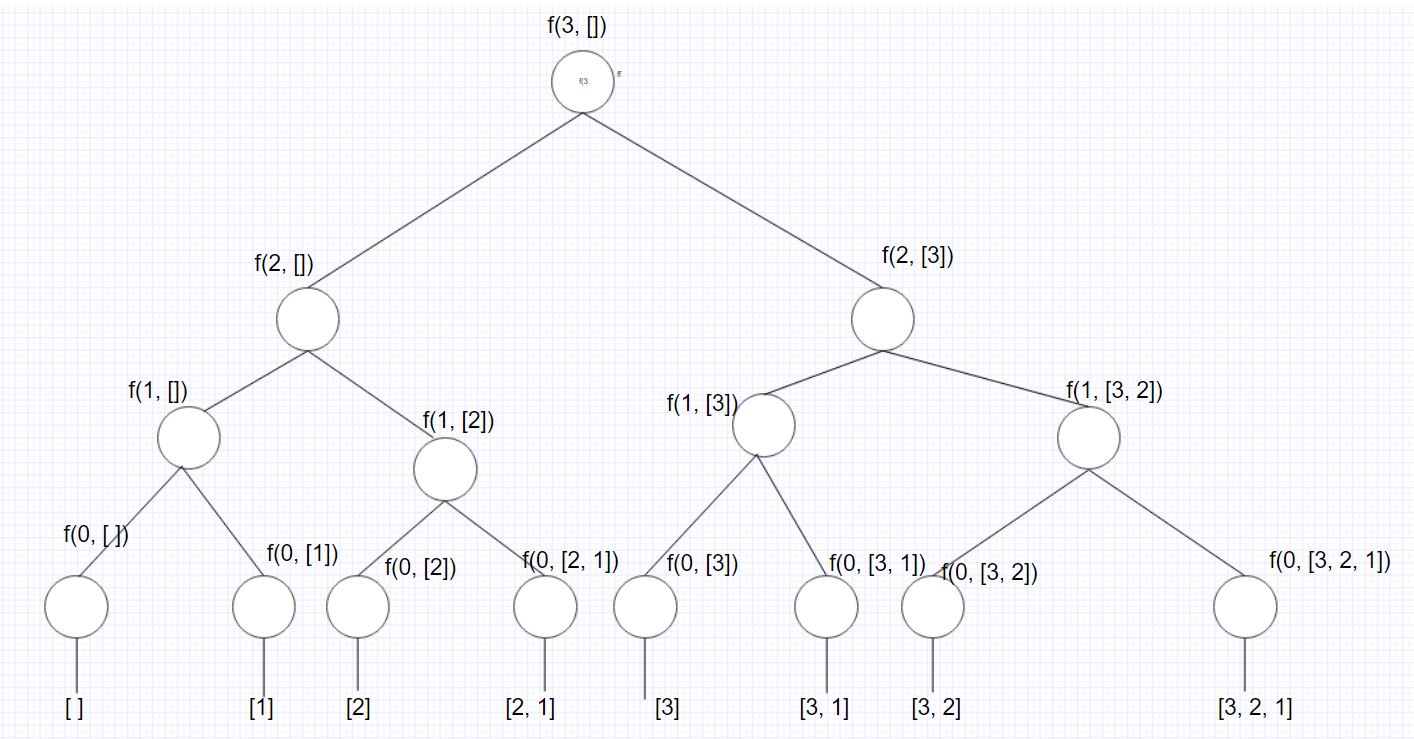
If it doesn’t make much sense don’t worry, here is the recursion tree recursion tree.

Here, we start with f(10, []) and at every states we take {2, 3, 7} and add to our answer list such that sum is greater than or equal to the number.
For every state f(sum, ans) we have 3 choices(if num is less than or equal to sum):
  • Include 2 to the ans and solve for sum - 2
  • Include 3 to the ans and solve for sum - 3
  • Include 7 to the ans and solve for sum - 7
We can see at level 1, we have:
             — f(8, [2]) // Take 2
   f(10, []) — f(7, [3]) // Take 3
             — f(3, [7]) // Take 7
The nodes marked in gray in the recursion tree are the answers to the problem.
Here is the complete code in Python:
def solve(sum, ans):
    # If sum becoms 0 we have found the required list
    if sum == 0:
        print(ans)
    
    # Include every other element to make the sum
    # Number that is included also can be included
    for elem in nums:
        if sum - elem >= 0:
            solve(sum - elem, ans + [elem])
 
# We want to make the sum from list nums
nums = [2, 3, 7]
sum = 10
 
# Call solve with sum and an empty list 
solve(sum, [])

Output:

[2,  2,  2,  2,  2]
[2,  2,  3,  3]
[2,  3,  2,  3]
[2,  3,  3,  2]
[3,  2,  2,  3]
[3,  2,  3,  2]
[3,  3,  2,  2]
[3,  7]
[7,  3]
Share:

Leetcode 78: Subsets

In this post, I'm going to talk about a problem on leetcode which asks us to find all the possible subsets of given list of integers. This problem is the base to solving other problems like subset sum and subset partitioning which I'll be discussing in coming posts. Let's get started: I'll be solving this problem using 2 techniques:
  1. Using Recursion
  2. Using Bitset
I'll be using cpp for this task.
Problem Statement: Given a set of distinct integers, nums, return all possible subsets (the power set).
Note: The solution set must not contain duplicate subsets.
Example: Input:
nums = [1,2,3]
Output:
[
  [3],
  [1],
  [2],
  [1,2,3],
  [1,3],
  [2,3],
  [1,2],
  []
]

Solution

1. Using Recursion

Firstly, I'll be discussing recursive approach to subset finding problem. Recursive problem is easy to visualise. Consider the given testcase [1, 2, 3]. Let solve(nums, n, subset) be the function that find subsets for array nums and number of elements n, initially called with an empty subset. So our initial call is :
vector<int>subset;
solve(nums, nums.size(), subset);
Now lets try visualising how recursion tree looks like.
Recursive Cases: For every state i.e (n), i,e position n - 1 of
solve(nums, n, subset)
we can have 2 choices:(Try to visualise recursion for arr = {1, 2, 3} )
  • Don’t include the current element in the subset i.e simply call
  • solve(nums, n - 1, subset);
    
  • Include current element in the subset
    subset.push_back(arr[n -  1]);
    solve(nums, n -  1, subset);
    
Base Cases:
Let’s think of base cases. The base cases are:
  • If n == 0 i.e no item left push the current subset to our subsets_ which is a vector of vector.
    if (n == 0){
    subsets_.push_back(subset);
    return;
    }
    
    Complete Code:
    class Solution {
    public:
    // Vector of vector of int to store all the subsets
    vector<vector<int>> subsets_;
    
    // Solve method that generates subset recursively
    void solve(vector<int> &nums, int n, vector<int> subset){
        // If size of array becomes 0, no elemnts are left
        // We push current subset to our subsets_ and return
        if (n == 0){
            subsets_.push_back(subset);
            return;
        }
        // Else we have 2 options:
    
        // Don't include the current element to subset
        solve(nums, n - 1, subset);
        // Incldue the current element in subset
        subset.push_back(nums[n - 1]);
        solve(nums, n - 1, subset);
    }
    
    // Solution method subsets
    vector<vector<int>> subsets(vector<int>& nums) {
        // Make an empty vector subset
        vector<int> subset;
        // Call solve function initially with an empty subset 
        solve(nums, nums.size(), subset);
        // Return subsets after calculation
        return subsets_;
    }
    };
    

2. Using Bitset

I have explained the bitset method on quora.
Share:

What are *args and **kwargs in Python

In this post, I'm going to talk about *args and **kwargs in Python which is a useful concept while handling multiple arguments.

They are called *args and **kwargs in Python which allows the function to accept optional arguments(positional and keyword).
Let’s see with an example.
At first, let’s make a simple function that accepts a single argument, first_name.
>>> def person(first_name):
...     print(first_name)
>>> person("Ram")
Ram
>>> person()
Traceback (most recent call last):
  File "<stdin>", line 1, in <module>
TypeError: person() missing 1 required positional argument: 'first_name'
What we can see is first_name is a compulsory argument. So, it is not possible to call the function without arguments.
Now, what we are going to do is make a function that accepts first_name as compulsory arguments followed by last_name as an optional argument.
One way to do this would be
>>> def person(first_name, last_name=""):
...     print(first_name, last_name)
>>> person("Ram") # Called with 1 argument
Ram
>>> person("Ram", "Shrestha") # Called with 2 arguments
Ram Shrestha
So far everything is going well. But now we want to scale the same function to accept first_name(compulsory) and last_name and middle_name as positional arguments.
One simple trick is to add another argument middle_name.
>>> def person(first_name, last_name="", middle_name=""):
...     print(first_name, middle_name, last_name)
But there is a more concise way to scale the function to accept multiple optional arguments called *args in Python.

1. *args

*args collects extra positional arguments as a tuple
The idea is simple. We modify our function definition as:
>>> def person(first_name, *args):
...     print(first_name, end = " ")
...     for names in reversed(args):
...             print(names, end=" ")
...     print()
>>> # Accepts single argument
>>> person("Ram")
Ram
>>> # Accepts 2 arguments 
>>> person("Ram", "Chhetri")
Ram Chhetri
>>> # Accepts 3 arguments
>>> person("Ram", "Chhetri", "Lal")
Ram Lal Chhetri
>>> person("Ram", "Chhetri", "Lal", "Krishna")
Ram Krishna Lal Chhetri
We can see that now our function can accept first_name followed by last_name, middle_name as optional positional arguments. To see if args is indeed a tuple you can add
print(type(args))
inside of function definition
Let’s see another example:

Task 1: Write a function to add N integers which are passed as arguments ( N >= 1)
Let’s do it for 1 integer
>>> def add(a):
...     return a
>>> add(8)
8
Nothing complicated. Now do it for 2 integers
>>> def add(a, b):
...     return a + b
>>> add(8, 2)
10
>>> add(8)
Traceback (most recent call last):
  File "<stdin>", line 1, in <module>
TypeError: add() missing 1 required positional argument: 'b'
Notice?? We lost the compatibility for 1 argument.
This is where *args comes handy:
>>> def add(a, *args):
...     sum = a
...     print(type(args))
...     for num in args:
...         sum += num
...     return sum
>>> add(8)
8
>> add(8, 2)
10
>> add(8, 2, 5)
15
See how flexible it is using *args. Note it is not necessary to name *args as args . We can name it whatever we like. But it must be preceded with a *.

2. **kwargs

**kwargs collects extra positional arguments as a dictionary.
Let’s return to our previous examples of function person:

Task 2: Modify function person so that it accepts additional optional parameters phone_num, email and so on…as keywords.
We modify our original function definition to accept a new argument **kwargs which is a keyword argument as:
>>> def person(first_name, *args, **kwargs):
...     print(first_name, end=" ")
...     for names in reversed(args):
...             print(names, end=" ")
...     print()
...     # Since kwargs is a dictionary
...     # we can iterate using .items()
...     for key, value in kwargs.items():
...             print(key, value)
>>> person("Ram", "Chhetri", "Lal", phone_num="981128331", email="anon@testmail.com")

Ram Lal Chhetri
phone_num 981128331
email anon@testmail.com
Since kwargs is of dictionary type. we can iterate over key, value using .items()
Notes:
  • *args and **kwargs are used to allow the function to accept a variable number of arguments
  • *args collects positional arguments as a tuple whereas **kwargs as dictionary
  • args and kwargs are just naming convention. You can name it whatever you like.
  • * and ** are also used in value unpacking
Share:

What are map, filter and reduce in Python

I wrote a post about map, filter and reduce on Python a while ago on quora. In this post, I'm going to talk about map filter and reduce in detail with examples.
Let's get started: Basically map, filter and reduce gives functional programming features to Python. But before diving into these three functions let me talk briefly about lambda(Hopefully I'll be writing another post about lambdas)

Lambda

Let me introduce how to use lambda(nameless) function so that we dont have to define function by def keyword everytime. The syntax for lambda is as follows:
lambda *params: result
Doesn't make sense. Let's see some examples:
Q1. Write a lambda function to square a given number.
>>> func = lambda x: x * x
>>> func(3)
9
Here what lambda does is take a parameter x and then return its squarei i.e
x is the argument
x * x is the return value
Note, we don't need explicit return statement. Let's try a similar example that adds two given numbers.
Q2. Write a lambda function to add 2 numbers
>>> func = lambda x, y: x  + y
>>> func(5, 4)
9
This lambda function is simply taking two numbers x and y and simply returning it's result. Let's make it more interesting by writing a lambda function to square an even number but cube an odd number.
Q3. Write a lambda function that square if the number is even and cube if it is odd
>>> func = lambda x: x * x if x % 2 == 0 else x ** 3
>>> func(2)
4
>>> func(3)
27
We have used if..else in python to handle two cases You might be wondering why lambdas are called nameless or anonymous function, right? Let's get to that part. We don't necessarily need to give name to our lambda function. Let's see how it works
>>> (lambda x: x * x )(9)
81
Here we can directly invoke the lambda function. I hope you now know the basic working of lambdas to get started with map, filter and reduce.

1. Map:

Syntax:
map(funct, iterable)
Basically what map does is it take a function and an iterable(list, tuple, string, set) and applies function to each of the members in the iterable. Map returns a map object which is an iterable. Let's work on some of the examples on Python Console. A quick help on map shows following output
>>> help(map)
Help on class map in module builtins:

class map(object)
 |  map(func, *iterables) --> map object
 |
 |  Make an iterator that computes the function using arguments from
 |  each of the iterables.  Stops when the shortest iterable is exhausted.
I've included only few lines of the output but you can explore for more. Let's see some examples to understand more about map. I'll be working all the examples on console.
Task 1. Given a list of integer square each number in the list
>>> def func(x):
...     return x * x
>>> l = [1, 2, 3, 4, 5]
>>> map(func, l)
Remember lambdas from above ?? Instead of making function using def , I'll be using lambdas to make code more concise(Remember lambdas are handy in many cases like sorting). Let's replace the func with lambda function.
>>> map(lambda x: x * x, l)
<map object at 0x000001D59CDE3278>
Aren't we supposed to get output like ?
[1, 4, 9, 16, 25]
Don't worry we'll get there. As mentioned previoulsy map function returns a map object. Since, map returns an iterable, we can still access the elements using iter() and next() until StopIteration is raised i.e there are no more elements left.
>>> it = map(lambda x: x * x, l)
>>> next(it)
1
>>> next(it)
4
>>> next(it)
9
>>> next(it)
16
>>> next(it)
25
>>> next(it)
Traceback (most recent call last):
  File "<stdin>", line 1, in <module>
StopIteration
We get the required results but this doesn't look quite interesting . An alternative way would be to loop across all the elements using a for loop.
>>> it = map(lambda x: x * x, l)
>>> for elem in it:
...     print(elem, end = " ")
...
1 4 9 16 25
This looks okayish. Can we do better like make a list out of the map object directly??
>>> l = list(map(lambda x: x * x, l))
>>> l
[1, 16, 81, 256, 625]
Okay it works as expected. Let's see an another example , maybe, square if the numbers are odd and cube if it is even.
Task 2. Given a list of integer square square if the numbers are odd and cube if it is even
I hope you know how to write lambda function that takes a number and does what the question is asking. If not read abut it in lambdas section. I'll be directly jumping to making a list out of map object. You may use loops or iter(), next() whenever necessary.
>>> l = list(map(lambda x: x * x if x % 2 == 0 else x ** 3, l))
>>> l
[1, 4, 27, 16, 125]
Task 3. Given a list of string integers like "1", "123", "5" write a function that convert the list of integer numbers.
>>> str_list = ["1", "2", "3"]
>>> l = list(map(lambda x: int(x), str_list))
>>> l
[1, 2, 3]
The above code works fine but there is some redundancy lambda x: int(x) . This is because there is already an inbuilt in Python named int that takes a paramer and return its integer equivalent.
>>> str_list = ["1", "2", "3"]
>>> l = list(map(int, str_list))
>>> l
[1, 2, 3]
Task 4. Given a list of string make a list of same size that gives the length of the string for every element
>>> str_list = ["Ram", "Hari"]
>>> l = list(map(len, str_list))
>>> l
[3, 4]
Task 5. Given a list of number separated by space as input . Write a function to make a list of the numbers using map This shorthand comes handy while reading inputs in competitive coding problems site.
>>> l = list(map(int, input().split()))
1 2 3 4 5
>>> l
[1, 2, 3, 4, 5]
Wondering what input().split() is doing? It simply splits a string by space while taking input and returns a list.
>>> l = input().split()
Ram Kumar
>>> l
['Ram', 'Kumar']
Compare it with
>>> l = input()
Ram Kumar
>>> l
'Ram Kumar'
See the difference? input().split() split the input string to make a list out of each strings other than space but if we dont use .split(), the input is taken as a single string no matter how many spaces are there.
Let's try working with multiple iterables. Task 6. Given two lists of strings one containing firstname and another containing last name of each i, write a function to make a single list with each firstname and lastname separated by space. Let's say we are given two lists
>>> first_name = ["Ram", "Sita", "Hari"]
>>> last_name = ["Pandey", "Chhetri", "Timalsina"]
What we want is output like
['Ram Pandey', 'Sita Chhetri', 'Hari Timalsina']
We can simply solve this problem using lambda function that takes 2 arguments and concatenate them with space in between.
lambda x, y: x + " " + y,
where x is the argument from first iterable and y is the argument from second.
>>> full_name = list(map(lambda x, y: x + " " + y, first_name, last_name))
>>> full_name
['Ram Pandey', 'Sita Chhetri', 'Hari Timalsina']
An alternative method to this would be using zip which is out of scope of this post.
>>> merged = list(zip(first_name, last_name))
>>> merged
[('Ram', 'Pandey'), ('Sita', 'Chhetri'), ('Hari', 'Timalsina')]
>>> full_name = list(map(lambda x: x[0] + " " + x[1], merged))
>>> full_name
['Ram Pandey', 'Sita Chhetri', 'Hari Timalsina']

2. Filter

Syntax:
filter(function, iterable)
Filter is similar to the map . The difference is that it returns a new filter object which is an iterable of the elements that satify the boolean function. As the name suggests, it is used to filter the elements based on a certain condition. Don't worry if it doesn't make sense right now. We'll get into more details with examples . Let's do some codes:
>>> help(filter)
Help on class filter in module builtins:

class filter(object)
 |  filter(function or None, iterable) --> filter object
 |
 |  Return an iterator yielding those items of iterable for which function(item)
 |  is true. If function is None, return the items that are true.
Task 1. Given a list of integer keep only the even numbers The lambda function that returns if a number is even easy to write. If you are having trouble writing it, revisit the lambda section above.
>>> (lambda x: x % 2 == 0)(1)
False
>>> (lambda x: x % 2 == 0)(2)
True
Now, we can use lambda and filter to perform the filter operation i.e separate only even numbers.
>>> l = [1, 2, 3, 4, 5]
>>> filter(lambda x: x % 2 == 0, l)
<filter object at 0x000001E60A8938D0>
Looks familiar? It is similar to the output of map .The only difference is we are getting a filter object insted of map. Since, it is also an iterable we can use iter(), nex() or a for loop to access the contents. But I would like to leave that as a exercise for you and directly dive into making a list out of filter object.
>>> l = [1, 2, 3, 4, 5]
>>> evens = list(filter(lambda x: x % 2 == 0, l))
>>> evens
[2, 4]
This works as expected.
Task 2. Given a list of passwords as string. Filter out all the weak passwords keeping only the vald passwords. For simplicity, a strong password is a password which is at least 8 characters long, contains at least one digit, at least one lowercase letter, at least one uppercase letter and at least 1 special symbols where special symbols are !@#$%^& Take your time to understand what question is asking. Basically, we are given a list of passwords and our task is to make list containing only the strong passwords. Sounds simple?
 >>> def is_strong(s):
...     return len(s) >= 8 and any([x.isupper() for x in s]) and any([x.islower() for x in s]) and any([x.isdigit() for x in s]) and any([(x in "!@#$%^&") for x in s])
>>> l = ["abcDEF1!", "abcdeF", "123456789", "aB1$", "123456789DDDDBBBaaa", "aaDDDD123$%"]
>>> strong = list(filter(is_strong, l))
>>> strong
['abcDEF1!', 'aaDDDD123$%']
Since , we are going to have a longer return statement, I've switched to normal functions instead of lambda . Remember readability matters. I could have written series of staements to check these 4 conditions but I choose to use a single statement . So what is_strong(s) does is take a string s and check if length of string is greater than or equal to 8 and contains any one of the uppercase letter, lowercase letter, digit and a special symbol characters. If you are seeing these string methods .isupper(), .islower(), .isdigit() for the first time here is how they work.
>>> "a".islower()
True
>>> "a".isupper()
False
>>> "A".isupper()
True
>>> "9".isdigit()
True
>>> "9".isupper()
False
Hope it clears your doubt. These are the string methods that returns a boolean value if the condition is satisfied(eg: isdigit() return true if the string is a digit). Let's see what any() is doing here.
>>> help(any)
Help on built-in function any in module builtins:

any(iterable, /)
    Return True if bool(x) is True for any x in the iterable.

    If the iterable is empty, return False.
>>> any([False, False])
False
>>> any([True, False, False])
True
What it is doing is is returns True if any one of the members in iterables is True , in our case if any one of the number is digit, uppercase, lowercase . Hope it clears your doubt.

3. Reduce

Syntax:
reduce(function, iterable, start)
Reduce applies a function of two arguments to items of sequence until it returns a single value. It takes a function that takes two arguments and an iterable and an start value. If start value is not specified explicitly it takes the first element as the start value.
Let's see what help has to offer.
>>> from functools import reduce
>>> help(reduce)
Help on built-in function reduce in module _functools:

reduce(...)
    reduce(function, sequence[, initial]) -> value

    Apply a function of two arguments cumulatively to the items of a sequence,
    from left to right, so as to reduce the sequence to a single value.
    For example, reduce(lambda x, y: x+y, [1, 2, 3, 4, 5]) calculates
    ((((1+2)+3)+4)+5).  If initial is present, it is placed before the items
    of the sequence in the calculation, and serves as a default when the
    sequence is empty.
Notice the first line? We are importing reduce from functools. We didn't need to import map and filter , right? This is because we don't need to import attributes that are in bultins.
>>> import builtins
>>> "map" in dir(builtins)
True
>>> "filter" in dir(builtins)
True
>>> "reduce" in dir(builtins)
False
Task 1: Given a list of integers, write a code that returns the total value obtained by multiplying the elements in the list.
>>> from functools import reduce
>>> l = [1, 2, 3, 4, 5, 6]
>>> mul = reduce(lambda x, y: x * y, l)
>>> mul
720
Task 2: Given a list of integers, write a code that returns the total value obtained by summing all the elements in the list.
>>> l = [1, 2, 3, 4, 5, 6]
>>> sm = reduce(lambda x, y: x + y, l, 0)
>>> sm
21
We can verify that it is indeed returning the sum by doing maths by hand or by using
>>> sum(l)
21
Task 3: Given a list of integers, write a code that returns the lcm of these values
>>> from functools import reduce
>>> from fractions import gcd
>>> l = [8, 19, 3, 5, 10, 2, 2, 4]
>>> lcm = reduce(lambda x, y: x * y // gcd(x, y), l)
>>> lcm
2280
Instead of implementing my own custom function to calculate LCM, I've used fractions module to calculate gcd and then find its lcm.
This kind of complete this post as of now. I'll be adding more examples.
Share:

DP: Longest Increasing Subsequence

The Longest Increasing Subsequence (LIS) problem is to find the length of the longest subsequence of a given sequence such that all elements of the subsequence are sorted in increasing order.
Note: The subsequence is not necessarily unique or contiguous.

In this post, I'll be solving classic DP problem which involves finding lis of a given array as well as some of its variations.
The problems related to LIS that I'll be seeing are :

Let's see problem 1 and 2. Both the problems are similar. The task is to find the length of the longest increasing(strictly) subsequence.
eg: [0, 8, 4, 12, 2, 10, 6, 14, 1, 9, 5, 13, 3, 11, 7, 15]
 Here length of LIS = 6. 
We can have multiple LIS with maximum length, but in this problem we are not concerned about the number of longest increasing subsequence(which we will see in 3rd problem here).


I'm gonna dive directly into bottom up approach for solving LIS in O(n ^ 2).

Approach:

Let's observe few scenarios.
A = [1 ,2 ,3, 4, 5]
If we have such array, then how can we find LIS upto length 1... 5. We're gonna need some kind of array to store those values. Let's say we make an array of size that of the given array and initialize with 1 as it is guaranteed that the minimum LIS for an array of length greater than 0 is always 1(Case when there is only 1 element)

What will be the approach to find lis upto index i????
Obviously we have to look at index from j = 0 to i - 1 and see if we can improve by taking element at index j such that element A[j] < A[i]

This roughly translates to below snipppet: lis[i] = max(lis[i], 1 + lis[j])
After building the LIS table , we can return the maximum value from the lis array

Implementation

int Solution::lis(const vector<int> &A) {
    // If the array is empty
    if(A.size() == 0){
            return 0;
        }
        // Initialize lis array with 1
        vector<int> lis(A.size(), 1);
        
        for(int i = 0; i < A.size(); i++){
            for(int j = 0; j < i; j++){
                // If jth element can be taken 
                // Maximize lis upto index i
                if(A[j] < A[i]){
                    lis[i] = max(lis[i], 1 + lis[j]);
                }
            }
        }
        return *max_element(lis.begin(), lis.end());
}


Share:

Leetcode 72. Edit Distance

Problem Link : https://leetcode.com/problems/edit-distance/

Given two words word1 and word2, find the minimum number of operations required to convert word1 to word2.
You have the following 3 operations permitted on a word:
  1. Insert a character
  2. Delete a character
  3. Replace a character
Example 1:
Input: word1 = "horse", word2 = "ros"
Output: 3
Explanation: 
horse -> rorse (replace 'h' with 'r')
rorse -> rose (remove 'r')
rose -> ros (remove 'e')
Example 2:
Input: word1 = "intention", word2 = "execution"
Output: 5
Explanation: 
intention -> inention (remove 't')
inention -> enention (replace 'i' with 'e')
enention -> exention (replace 'n' with 'x')
exention -> exection (replace 'n' with 'c')
exection -> execution (insert 'u')

Solution:

Edit distance between two strings is the minimum number of operations required to convert one string to another. We are given two strings word1 and word2 and are asked to calculate minimum number of operations(insert, delete or replace) required to convert word1 to word2.
Let's try to solve this problem recursively with caching/ top down
class Solution {
public:
    
    // Stores precomputed (i, j) i,e cost for s with length i and
    // t with j length
    map<pair<int, int>, int> mp;
    
    string s, t;
    int helper(int i, int j){
        
        // If already computed for length i and j simply return computed value
        if (mp.find({i, j}) != mp.end()){
            return mp[{i, j}];
        }
        
        // If length of the first string is 0
        // Then we need to insert all the characters equal to length of 
        // second string
        // eg: s = "" and t = "ram"
        // Then we need to insert 3 characters "ram" into s
        
        if(i == 0){
            return j;
        }
        
        // If length of second string is 0
        // Then we need to delete 3 characters from first string
        if(j == 0){
            return i;
        }
        
        // If the corresponding ith and jth character matches 
        // we don't need any operations
        // we just solve for (i - 1) length and (j - 1) length of s and t
        // eg: s = "ram" and t = "cram"
        // Here s[2] == t[3]. So we dont need any additional operation
        // We just solve for its smaller instance i.e s becomes "ra" and t becomes "cra"
        if(s[i - 1] == t[j - 1]){
            return helper(i - 1, j - 1);
        }
        
        // Insert 
        // s = "horse", t = "ros"
        // We insert character 's' costing 1 operations
        // "horses" and "ros" i.e we can eliminate matcging characters from last
        // Then problem reduces to "horse" and "ro"
        // i.e length of string s doesn't change but string t reduces by size 1
        int ins = 1 + helper(i , j - 1);
        
        // Replace
        // eg: = "horse", t = "ros"
        // We can replace last character of string s to 's' with 1 cost operation
        // Then we can eliminate matching characters
        // Then problem reduces to "hors" and "ro"
        // i.e length of s reduces by 1 and t reduces by 1
        int rep = 1 + helper(i - 1, j - 1);
        
        // Delete
        // eg: "horse", t = "ros"
        // We can delete last character from string s with cost 1
        // Then problem reduces to "hors" and "ros"
        // i.e length of s reduces by 1 but length of t doesnt change
        int del = 1 + helper(i - 1, j);
        
        // Save the computed result in dictionary
        mp[{i, j}] = min({ins, rep, del});
        return mp[{i, j}];
        
    }
    int minDistance(string word1, string word2) {
       s = word1;
       t = word2;
       return helper(word1.size(), word2.size());
    }
};

Top-Down approach passes the testcases but sometimes may cause stack overhead due to more recursive calls and you may face issues in language like python unless you explicitly set recursion limit.
So let's try translating the code to bottom up dp.
The first thing we can observe is we are interested only in two parameters :

  • length of word1 (i)
  • length of word2 (j)
We can write f(i, j) as dp[i][j] which stores edit distance between two string word1 and word2

Translating the code is straight forward, just replace the function call with dp array states. See the implementation
class Solution {
public:
    int minDistance(string word1, string word2) {
        int n = word1.size();
        int m = word2.size();
        vector<vector<int>> dp(n + 1, vector<int>(m + 1, -1));
        
        for(int i = 0; i <= n; i++){
            dp[i][0] = i;
        }
        
         for(int j = 0; j <= m; j++){
            dp[0][j] = j;
        }
        for(int i = 1; i <= n; i++ ){
            for(int j = 1; j <= m; j++){
                if(word1[i - 1] == word2[j - 1]){
                    dp[i][j] = dp[i - 1][j - 1];
                }
                else{
                    //Insert
                    dp[i][j] = 1 + dp[i][j - 1];
                    //Delete
                    dp[i][j] = min(dp[i][j], 1 + dp[i - 1][j]);
                    //Replace
                    dp[i][j] = min(dp[i][j], 1 + dp[i - 1][j - 1]);
                    
                }
            }
        }
        return dp[n][m];
        
    }
};


Share:

Leetcode 931. Minimum Falling Path Sum

Problem Link: https://leetcode.com/problems/minimum-falling-path-sum/


Given a square array of integers A, we want the minimum sum of a falling path through A.
A falling path starts at any element in the first row, and chooses one element from each row.  The next row's choice must be in a column that is different from the previous row's column by at most one.

Example 1:
Input: [[1,2,3],[4,5,6],[7,8,9]]
Output: 12
Explanation: 
The possible falling paths are:
  • [1,4,7], [1,4,8], [1,5,7], [1,5,8], [1,5,9]
  • [2,4,7], [2,4,8], [2,5,7], [2,5,8], [2,5,9], [2,6,8], [2,6,9]
  • [3,5,7], [3,5,8], [3,5,9], [3,6,8], [3,6,9]
The falling path with the smallest sum is [1,4,7], so the answer is 12.

Note:
  1. 1 <= A.length == A[0].length <= 100
  2. -100 <= A[i][j] <= 100

Solution:

We are given a square grid of size n * n.
What we want is the minimum falling path sum. ie. the minimum sum while falling through row 0 to row (n - 1)
The constraints in the problem is while falling from column of ith row to (i + 1)th row, we can fall on either of the columns {j - 1, j , j+ 1} as it is mentioned that the choice of next row must be in a column that is different from the previous row's column by at most one.


Similar to other grid dp problems, I'm gonna start with the case when I'm at (i, j) cell. How can I reach (i, j) cell??
We can reach (i, j) cell from either of (i - 1, j - 1), (i - 1, j) or (i - 1, j - 1) cell.


Let dp[i][j] gives the minimum possible falling path sum. Then
 dp[i][j] = A[i][j] + min(dp[i - 1][j - 1], dp[i - 1][j], dp[i - 1][j - 1]) 
We must consider a special case for the first row(0th). There is no way to fall to 0th row so, minimum falling path cost is given by the weight of the cell itself
 dp[0][i] = A[0][i] 
Now we are almost done with the solution , for every cell(i, j) form(1, 0) to (n - 1, n- 1) we fill up the dp table in bottom up manner. See the implementation .


Implementation: 

class Solution {
public:
    int minFallingPathSum(vector<vector<int>>& A) {
        
        // Size of grid
        int n = A.size();
        
        // dp[i][j] gives the minimum sum of falling path for cell(i, j)
        vector<vector<int>> dp(n, vector<int> (n, INT_MAX));
        
        // For cell at 0th row we can't fall from any row
        // So for all cells at 0th row minimum sum of falling is the
        // value of eleement itself
        for(int i = 0; i < n; i++){
            dp[0][i] = A[0][i];
        }
        
        
        // Suppose our ans is infinite
        int ans = INT_MAX;
        
        // For all rows from 1 to n - 1
        // We can fall to cell (i, j) from (i - 1, j - 1) or (i - 1, j) or (i - 1, j          + 1)
        
        for(int i  = 1; i < n; i++){
            for(int j = 0; j < n; j++){
                
                // if cell(i, j) is not of last column
                // we can fall from previous row (i - 1, j + 1) with
                //  column greater than 1
                if(j + 1 < n){
                   dp[i][j] =   min(dp[i][j], dp[i - 1][j + 1]);
                }
                // if cell(i, j) is not of first column
                // we can fall from previous row (i - 1, j - 1) with
                //  column less than 1
                if(j - 1 >= 0){
                     dp[i][j] =  min(dp[i][j], dp[i - 1][j - 1]);
                }
                
                // Otherwise we can fall directly from the cell above it(i - 1, j -                 1)
                dp[i][j] =  min(dp[i][j] , dp[i - 1][j]);
                
                // Cost of falling is minimum of the paths and current value of the cell (i, j)
                dp[i][j] += A[i][j];
                
            }
        }
        
        
        // Loop through all elements at last row and compute the minimum value
        // which is the minimum sum of a falling path
        for(auto x: dp[n - 1]){
            ans = min(ans, x);
        }
        return ans;
    }  
};


Share: